“Treat symptoms, Improve Healthiness, Cure Illness”
The suggestion that the government bureaucracies should regulate supplements like they regulate drugs. This concept can be caused by simplified view that often leads to misunderstanding:
- we take drugs to prevent and treat illness, sometimes cure
- we take supplements to prevent and treat illness, sometimes cure
Our bureaucratic medical systems make a clear distinction, saying: “The disclaimer must also state that the dietary supplement product is not intended to “diagnose, treat, cure or prevent any disease,” because only a drug can legally make such a claim.” – FDA.GOV
- only a drug can (legally) claim to diagnose, treat, cure or prevent (disease)
- supplements can only (legally) make health claims, nutrient content claims, and structure/function claims, they cannot claim to diagnose, treat, cure or prevent (disease).
Of course this legal distinction is nonsense in actual practice. Most drugs make no claim to diagnose, treat, cure, or prevent disease, instead claiming to treat signs and symptoms of disease without any attempt to cure. At the same time, many supplements can be used to diagnose, treat, and cure specific illnesses, recognized as diseases or not, when the individual is suffering from a deficiency. When there is no deficiency, the supplement does not have these effects.
This diagram illustrates differences between supplements, treatments, and cures.
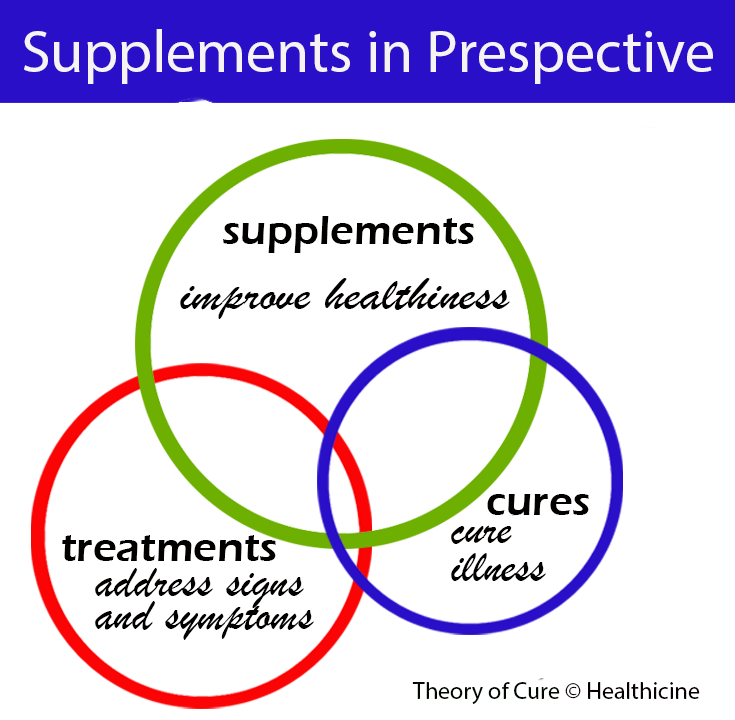
A cure is a product or action that cures an illness. Note: the concept of illness is broader than that of disease. Medically, a case of disease only exists after diagnosis. Many illnesses are never – and many cannot – be diagnosed.
A treatment is a product or action we take to address signs and symptoms of illness, but not to cure. If it cures – we can call it a cure, not a treatment.
- Treatments are designed to address signs and symptoms of illness, sometimes they improve healthiness, sometimes they cure.
- Cures are designed to cure illness, sometimes they improve healthiness, sometimes they can to treat signs and symptoms of illness.
- Supplements are designed to improve healthiness, sometimes they can treat signs and symptoms of illness, sometimes they cure.
Healthicines
Many people take – and many medical practitioners (and of course supplement marketers) recommend – supplements to improve healthiness when no disease is present.
Many drug manufacturers claim their products improve healthiness and thus prevent disease – and this claim is repeated by doctors and patients.
But, we don’t have a name for products or actions that “improve healthiness.” In the theory of cure, that word is healthicine. We can replace the word “supplement” in the above diagram with “healthicine” – and thus improve our understanding.
Improve Healthiness
With this model, we can clarify a legal (bureaucratic) distinction between drugs and supplements. Drugs are products and actions that are legally allowed to be marketed as treatments or cures for illness. Healthicines (supplements) are products or action that are legally allowed to be marketed as improving healthiness. This distinction is illustrated thus:
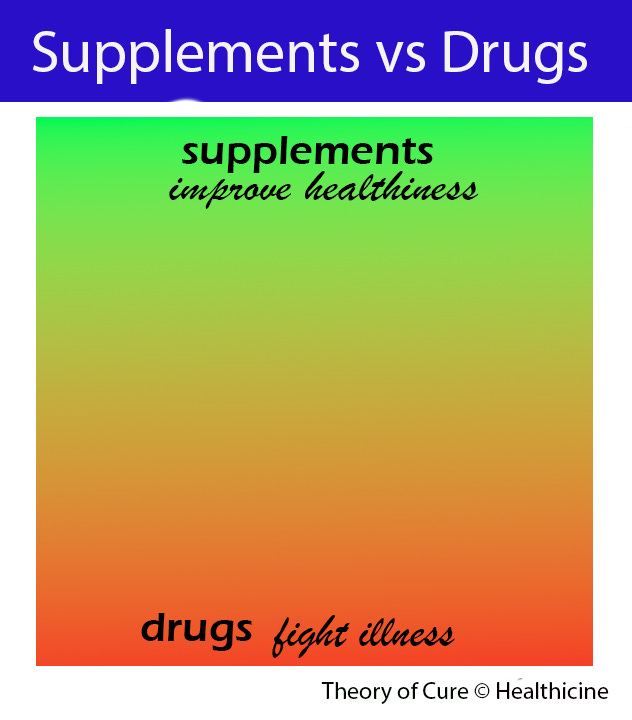
With this perspective in mind, we can see that we need different rules for healthicines than those for drugs.
Drugs Fight Illness
Fighting can be dangerous. Fighting illness often means making dangerous changes. In many cases, we fight illness by first reducing healthiness – with the expectation that healthiness will naturally recover. Sometimes, we are forced to accept a reduction in healthiness to fight a deadly illness. A diabetic patient with gangrene in their leg may require an amputation to protect their life.
Fighting signs, symptoms and causes of illness might require a dangerous drugs or surgery. We need to study the drug’s effectiveness vs it’s dangers and decide, for each drug, and for each case of illness, if the need is greater than the risk.
We need to know that and measure
- how effectively the drug fights disease.
- In what situations the drug successfully fights disease
- How much danger it presents to healthiness.
Healthicines Improve Healthiness
Improving healthiness is not dangerous. It is not possible to have an excess of health. When a supplement claims to improve healthiness we need a different standard.
We need to know that, and measure
- How effectively the supplement improves healthiness
- In what situations the supplement improves healthiness
- How much danger the supplement presents.
Supplements are not Drugs, Drugs are not Supplements
The standards we have developed to test the effectiveness and safety of drugs used to treat and cure illness are simply not effective to test the effectiveness and safety of supplements to improve healthiness. We need a different paradigm.
Healthicine: The Arts and Science of Health and Healthiness
Today, we have many sciences of medicine.
But we have no science and no studies of healthicine, the art and science of health and healthiness. It’s time to study health – and when we do, we will find many missing cures.
to your health, tracy
Author: A New Theory of Cure
Founder: Healthicine, the Arts and Sciences of Health and Healthiness