For centuries, medical experts and philosophers have attempted to define health, with little success. We might forgive Hippocrates for describing health “as a delicate balance of four fluids: blood, yellow bile, black bile, and phlegm, with imbalance leading to illness,” or the traditional medical experts of China for describing health as “the opposing forces of yin and yan, the notion of five elements (wood, fire, earth, metal and water), and the concept of chi”. In 1949, the World Health Organization defined health, as “a complete state of physical, mental and social well-being, and not merely the absence of disease or infirmity“, and since then their definition has been often criticized and widely ignored. It has not lead to any success in improving health nor fighting illness. Since that time, there have been few isolated attempts to define health, and all have been largely ignored by the medical and other professions.
Why can’t we create a useful definition of health? The answer is actually quite simple. It’s due to a simple misunderstanding, which is illustrated in this diagram. We need to understand four words, because one of them is largely missing in both ancient, and modern medicines.
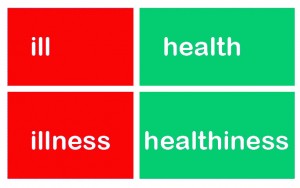 The four words are ill and illness, and health and healthiness.
Let’s think about illness for a moment. What is the difference between ‘ill’ and illness? An ill, as a noun, is a problem or a misfortune, an evil, or harm. How could you wish him ‘ill’. Ill cannot be measured, nor improved upon. Continue reading →